Ogni favola è un gioco
Every Tale is a Playful Journey
«No, no, e ancora no! Dai nonni in Puglia ci andiamo d’estate, quando si puo giocare sulla spiaggia di San Vito con i paguri, si può bere la limonata fresca dal carretto della famiglia Benemerito, si può stare svegli fino a tardi a guardare le stelle. Che ci andiamo a fare d’inverno?». Bianca era irremovibile. Eppure sua madre aveva fatto di tutto per prenderle, quelle ferie. E quando ne aveva avuto conferma, la prima cosa a cui aveva pensato era stato proprio il sorriso di Bianca. Per la prima volta da quando era nata, avrebbe passato le vacanze di Natale “giù”. E invece...
«Dai, giochiamo! Facciamo un disegno! Leggiamo un libro!», Francesca cercava in tutti i modi di strappare un sorriso a Bianca, la sua cuginetta del Nord. Era cosi felice di trascorrere le vacanze di Natale con lei. «Devo trovare qualcosa di speciale da fare insieme», pensava tra sé quella sera, mentre la vedeva dormire nel lettino accanto.
«Bianca, svegliati, c'è qualcuno alla finestra».
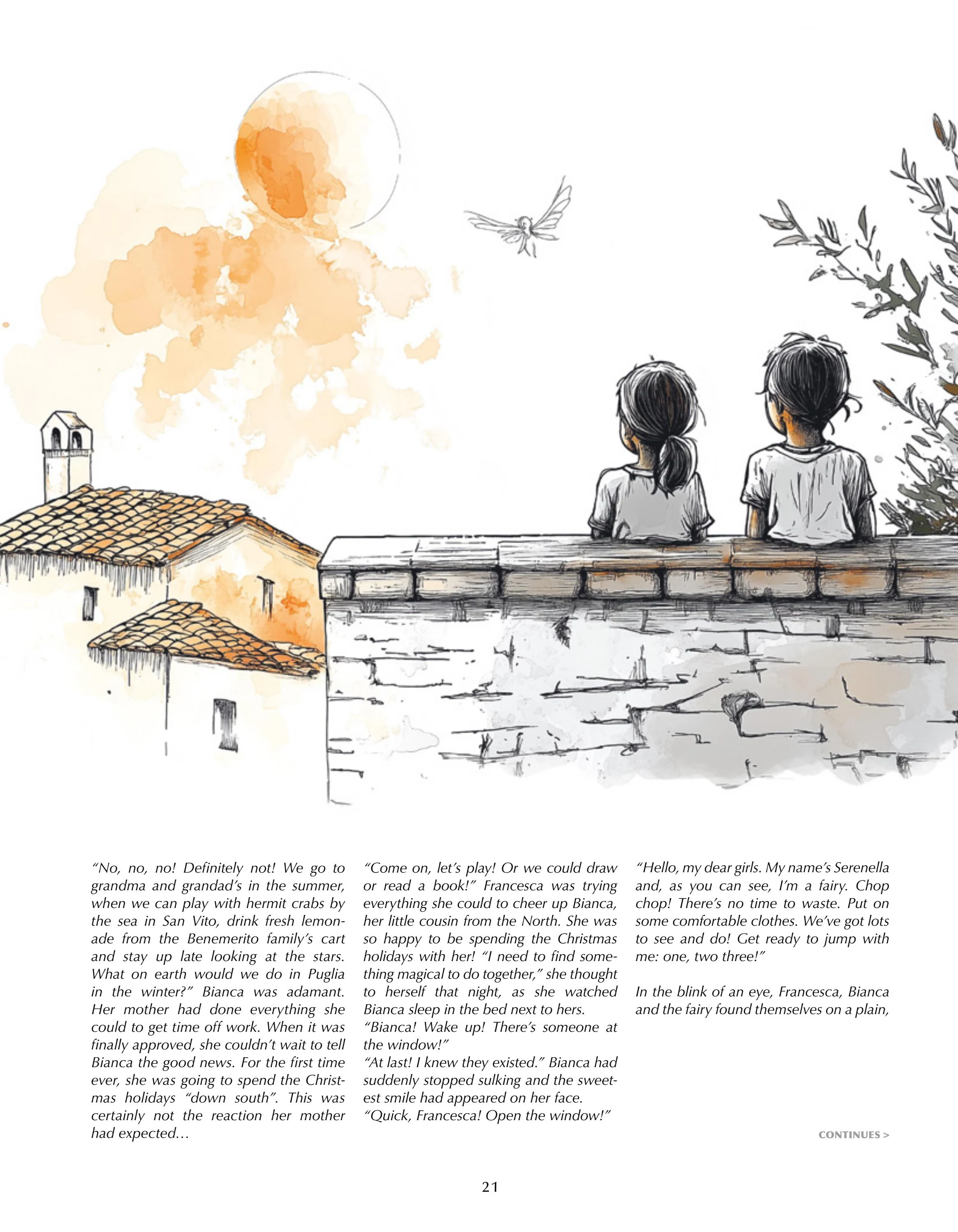
«Finalmente, lo sapevo che esistevano». D’un tratto, il broncio di Bianca era scomparso. Al suo posto un dolcissimo sorriso. «Dai Franci, apri la finestra».
«Buongiorno fanciulle, Fata Serenella al vostro servizio. Potete chiamarmi solo Fatina. Orsu, non perdiamo tempo. Mettete vestiti comodi e partiamo. Abbiamo tantissimo da fare e da vedere. Pronte a saltare insieme a me? Uno, due e tre».
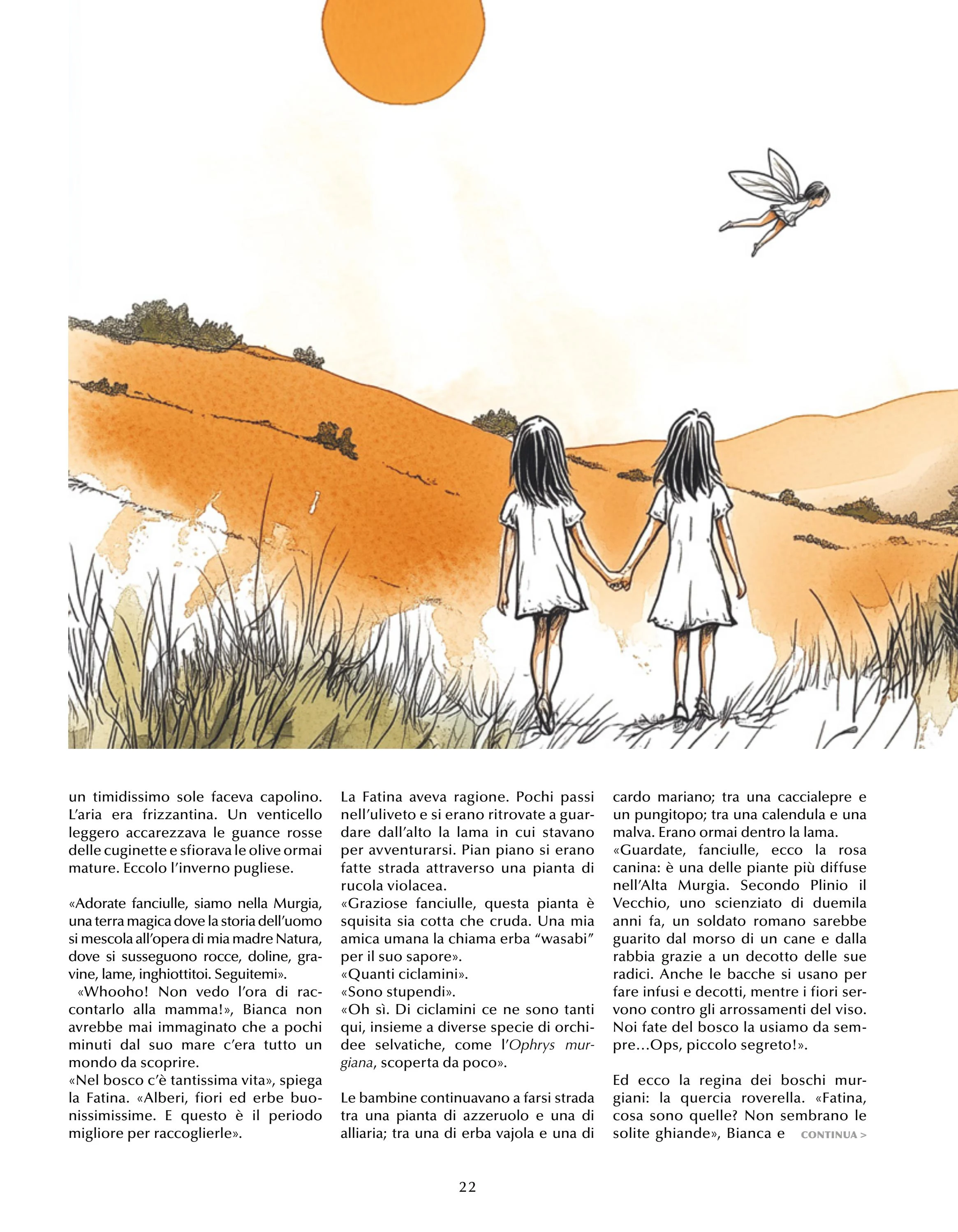
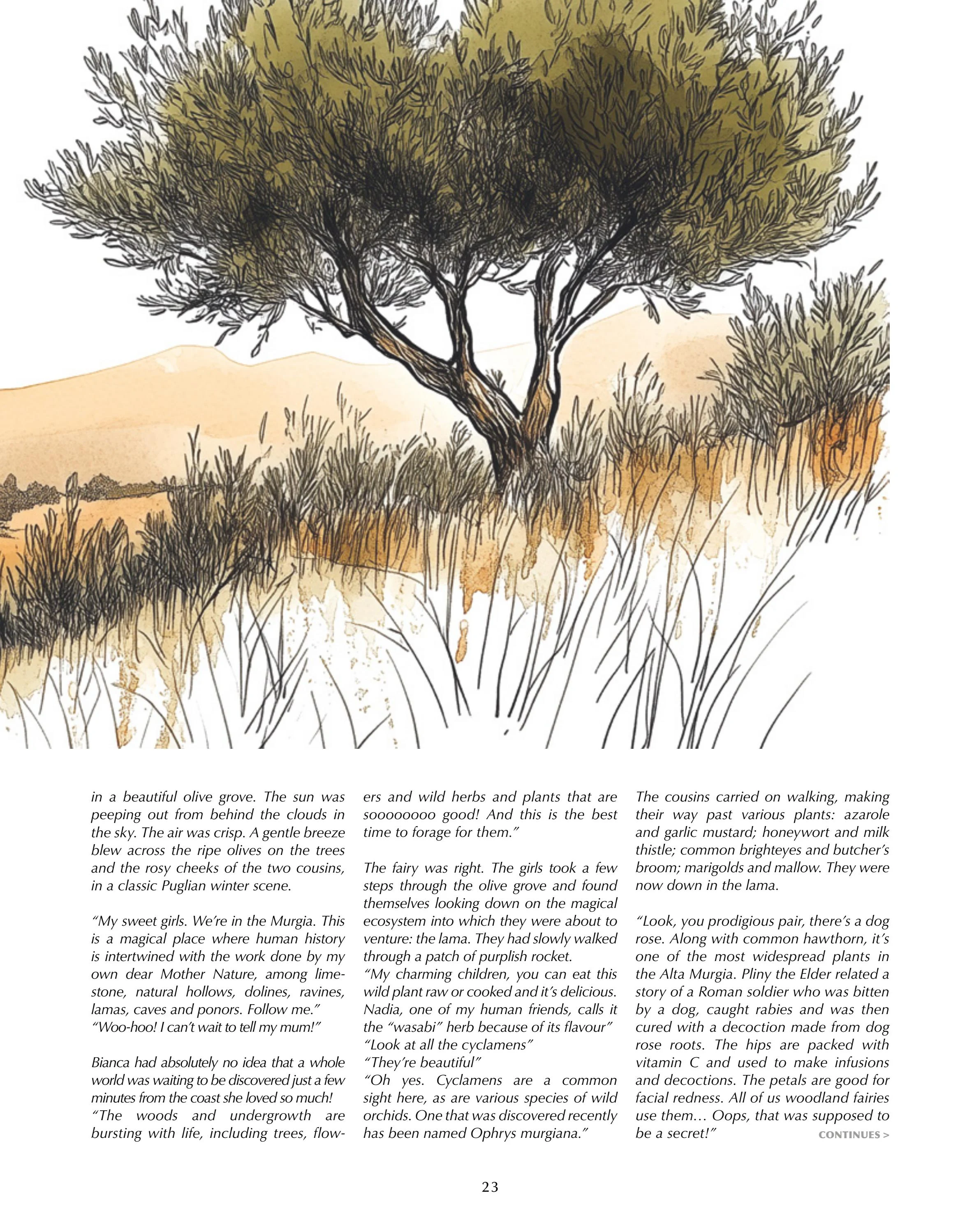
In un batter d’ali, Francesca, Bianca e la Fatina si erano ritrovate in un uliveto pianeggiante. Tra le nuvole nel cielo, un timidissimo sole faceva capolino. Laria era frizzantina. Un venticello leggero accarezzava le guance rosse delle cuginette e sfiorava le olive ormai mature. Eccolo I'inverno pugliese.
«Adorate fanciulle, siamo nella Murgia, una terra magica dove la storia dell’uomo si mescola all’opera di mia madre Natura, dove si susseguono rocce, doline, gravine, lame, inghiottitoi. Seguitemi». «Whooho! Non vedo l'ora di raccontarlo alla mamma!», Bianca non avrebbe mai immaginato che a pochi minuti dal suo mare c’era tutto un mondo da scoprire. «Nel bosco c'è tantissima vita», spiega la Fatina. «Alberi, fiori ed erbe buonissimissime. E questo è il periodo migliore per raccoglierle».
La Fatina aveva ragione. Pochi passi nell'uliveto e si erano ritrovate a guardare dall’alto la lama in cui stavano per avventurarsi. Pian piano si erano fatte strada attraverso una pianta di rucola violacea.
«Graziose fanciulle, questa pianta è squisita sia cotta che cruda. Una mia amica umana la chiama erba “wasabi” per il suo sapore».
«Sono stupendi».
«Oh si. Di ciclamini ce ne sono tanti qui, insieme a diverse specie di orchidee selvatiche, come I'Ophrys murgiana, scoperta da poco».
Le bambine continuavano a farsi strada tra una pianta di azzeruolo e una di alliaria; tra una di erba vajola e una di cardo mariano; tra una caccialepre e un pungitopo; tra una calendula e una malva. Erano ormai dentro la lama. «Guardate, fanciulle, ecco la rosa canina: è una delle piante più diffuse nell’Alta Murgia. Secondo Plinio il Vecchio, uno scienziato di duemila anni fa, un soldato romano sarebbe guarito dal morso di un cane e dalla rabbia grazie a un decotto delle sue radici. Anche le bacche si usano per fare infusi e decotti, mentre i fiori servono contro gli arrossamenti del viso. Noi fate del bosco la usiamo da sempre...Ops, piccolo segreto!».
Ed ecco la regina dei boschi murgiani: la quercia roverella. «Fatina, cosa sono quelle? Non sembrano le solite ghiande», Bianca e cONTINUA > «Adorate fanciulle, siamo in una terra magica dove la storia dell'uomo si mescola all'opera di mia madre Natura»
Francesca se ne stavano ferme con il naso all’insù.
«Infatti non lo sono, quelle sono le galle! Hanno tante forme, alcune sembrano biglie, e in passato i bambini le usavano per giocare. Sono una protezione della pianta contro un parassita, una sorta di culla per piccoli insetti che l'albero crea per difendere in realta se stesso». «Fatina, che bella la natura».
«Certo. Pensate che da sola ha scavato le grotte. Ce n’é una qui vicino. Andiamo! Gli uomini hanno sempre usato le grotte, in tempi antichissimi e in tempi più recenti. Negli anfratti i briganti pugliesi nascondevano i bottini e le armi. Ma questa è una pagina di storia complessa. La prossima volta vi raccontero di quando ho incontrato il Sergente Brigante Romano».
Le cuginette seguivano attente la Fatina mentre avanzavano tra rami di ferula e fiori di grespino verso il cuore della lama.
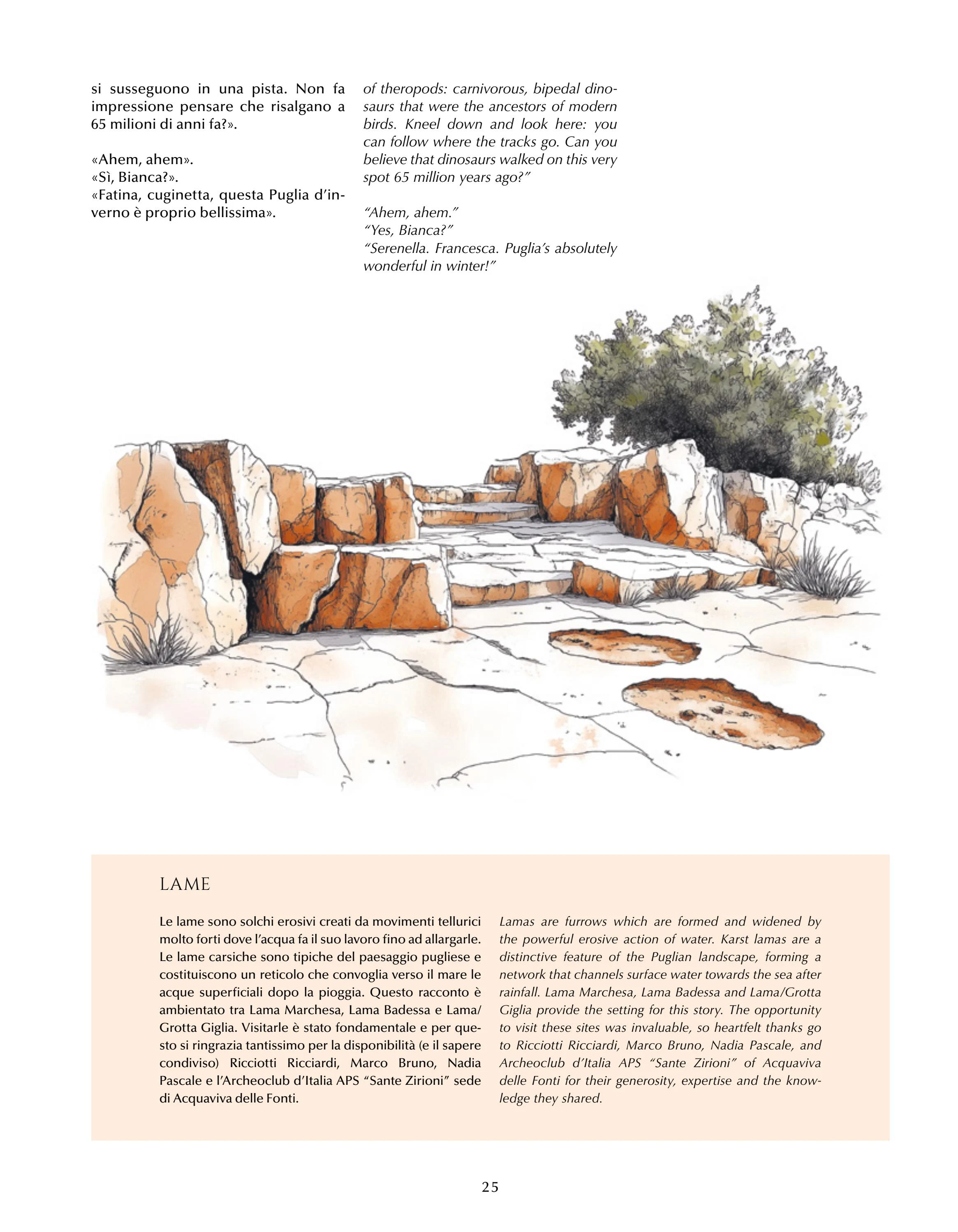
Ed eccola lì, timida e allo stesso tempo maestosa, la roccia con le orme dei dinosauri. «<Mie gentili fanciulle, queste sono impronte di Teropodi, dinosauri carnivori e bipedi, antenati degli uccelli. Seguitele, guardate come si susseguono in una pista. Non fa impressione pensare che risalgano a 65 milioni di anni fa?».
«Si, Bianca?».
«Fatina, cuginetta, questa Puglia d'’inverno è proprio bellissima».
## LAME
Le lame sono solchi erosivi creati da movimenti tellurici molto forti dove I'acqua fa il suo lavoro fino ad allargarle. Le lame carsiche sono tipiche del paesaggio pugliese e costituiscono un reticolo che convoglia verso il mare le acque superficiali dopo la pioggia. Questo racconto è ambientato tra Lama Marchesa, Lama Badessa e Lama/ Grotta Giglia. Visitarle è stato fondamentale e per questo si ringrazia tantissimo per la disponibilità (e il sapere condiviso) Ricciotti Ricciardi, Marco Bruno, Nadia Pascale e l'Archeoclub d’Italia APS “Sante Zirioni” sede di Acquaviva delle Fonti.
“No, no, no! Definitely not! We go to grandma and grandad’s in the summer, when we can play with hermit crabs by the sea in San Vito, drink fresh lemonade from the Benemerito family’s cart and stay up late looking at the stars. What on earth would we do in Puglia in the winter?” Bianca was adamant. Her mother had done everything she could to get time off work. When it was finally approved, she couldn’t wait to tell Bianca the good news. For the first time ever, she was going to spend the Christmas holidays “down south”. This was certainly not the reaction her mother had expected...
“Come on, let’s play! Or we could draw or read a book!” Francesca was trying everything she could to cheer up Bianca, her little cousin from the North. She was so happy to be spending the Christmas holidays with her! “I need to find something magical to do together,” she thought to herself that night, as she watched Bianca sleep in the bed next to hers. “Bianca! Wake up! There’s someone at the window!”
“At last! I knew they existed.” Bianca had suddenly stopped sulking and the sweetest smile had appeared on her face. “Quick, Francesca! Open the window!”
“Hello, my dear girls. My name’s Serenella and, as you can see, I'm a fairy. Chop chop! There’s no time to waste. Put on some comfortable clothes. We've got lots to see and do! Get ready to jump with me: one, two three In the blink of an eye, Francesca, Bianca and the fairy found themselves on a plain, in a beautiful olive grove. The sun was peeping out from behind the clouds in the sky. The air was crisp. A gentle breeze blew across the ripe olives on the trees and the rosy cheeks of the two cousins, in a classic Puglian winter scene.
“My sweet girls. We're in the Murgia. This is a magical place where human history is intertwined with the work done by my own dear Mother Nature, among limestone, natural hollows, dolines, ravines, lamas, caves and ponors. Follow me.”
“Woo-hoo! I can't wait to tell my mum!”
Bianca had absolutely no idea that a whole world was waiting to be discovered just a few minutes from the coast she loved so much!
“The woods and undergrowth are bursting with life, including trees, flowers and wild herbs and plants that are 500000000 good! And this is the best time to forage for them.”
The fairy was right. The girls took a few steps through the olive grove and found themselves looking down on the magical ecosystem into which they were about to venture: the lama. They had slowly walked through a patch of purplish rocket.
“My charming children, you can eat this wild plant raw or cooked and it’s delicious. Nadia, one of my human friends, calls it the “wasabi” herb because of its flavour” “Look at all the cyclamens”
“They’re beautiful”
“Oh yes. Cyclamens are a common sight here, as are various species of wild orchids. One that was discovered recently has been named Ophrys murgiana.”
The cousins carried on walking, making their way past various plants: azarole and garlic mustard; honeywort and milk thistle; common brighteyes and butcher’s broom; marigolds and mallow. They were now down in the lama.
“Look, you prodigious pair, there’s a dog rose. Along with common hawthorn, it’s one of the most widespread plants in the Alta Murgia. Pliny the Elder related a story of a Roman soldier who was bitten by a dog, caught rabies and was then cured with a decoction made from dog rose roots. The hips are packed with vitamin C and used to make infusions and decoctions. The petals are good for facial redness. All of us woodland fairies use them... Oops, that was supposed to be a secret!” CONTINUES > "My sweet girls. In this magical place, human history's intertwined with the work of Mother Nature"
And here’s the queen of the Murgia woods: the downy oak. “Serenella, what are they? They don't look like normal acorns,” asked Bianca and Francesca as they stood looking up.
“That’s because they aren’t! They re galls. They come in lots of different shapes and some of them look like marbles — children used to play with them. Plants use them to protect themselves from parasites. They're a bit like cradles for little insects, but the trees actually make them as a form of defence.
“Oh Serenella, isn’t nature marvellous?” “It certainly is. It can even make caves all by itself. Look, there’s one just there. Let’s go back up a second! People have always used caves, both in the distant past and more recently. They were once the haunt of Puglian brigands, who hid the arms that they trafficked and the hauls from their raids. It’s a complicated chapter of history, my young friends. Another time, I'll tell you about when I met a brigand called Sergente Romano.”
The cousins followed the fairy as they walked past giant fennel and Sonchus Oleraceus on their way into the heart of the lama.
And there it was, right before their excited eyes. An unassuming yet majestic assortment of dinosaur tracks in the rock. “My darling girls, these are the footprints of theropods: carnivorous, bipedal dinosaurs that were the ancestors of modern birds. Kneel down and look here: you can follow where the tracks go. Can you believe that dinosaurs walked on this very spot 65 million years ago?”
“Ahem, ahem.” “Yes, Bianca?” “Serenella. Francesca. Puglia’s absolutely wonderful in winter!
Lamas are furrows which are formed and widened by the powerful erosive action of water. Karst lamas are a distinctive feature of the Puglian landscape, forming a network that channels surface water towards the sea after rainfall. Lama Marchesa, Lama Badessa and Lama/Grotta Giglia provide the setting for this story. The opportunity to visit these sites was invaluable, so heartfelt thanks go to Ricciotti Ricciardi, Marco Bruno, Nadia Pascale, and Archeoclub d’Italia APS “Sante Zirioni” of Acquaviva delle Fonti for their generosity, expertise and the knowledge they shared.