

Dodici racconti raminghi pugliesi
Twelve Roaming Puglian Stories
## GENNAIO — LA POZIONE DI LOCOROTONDO
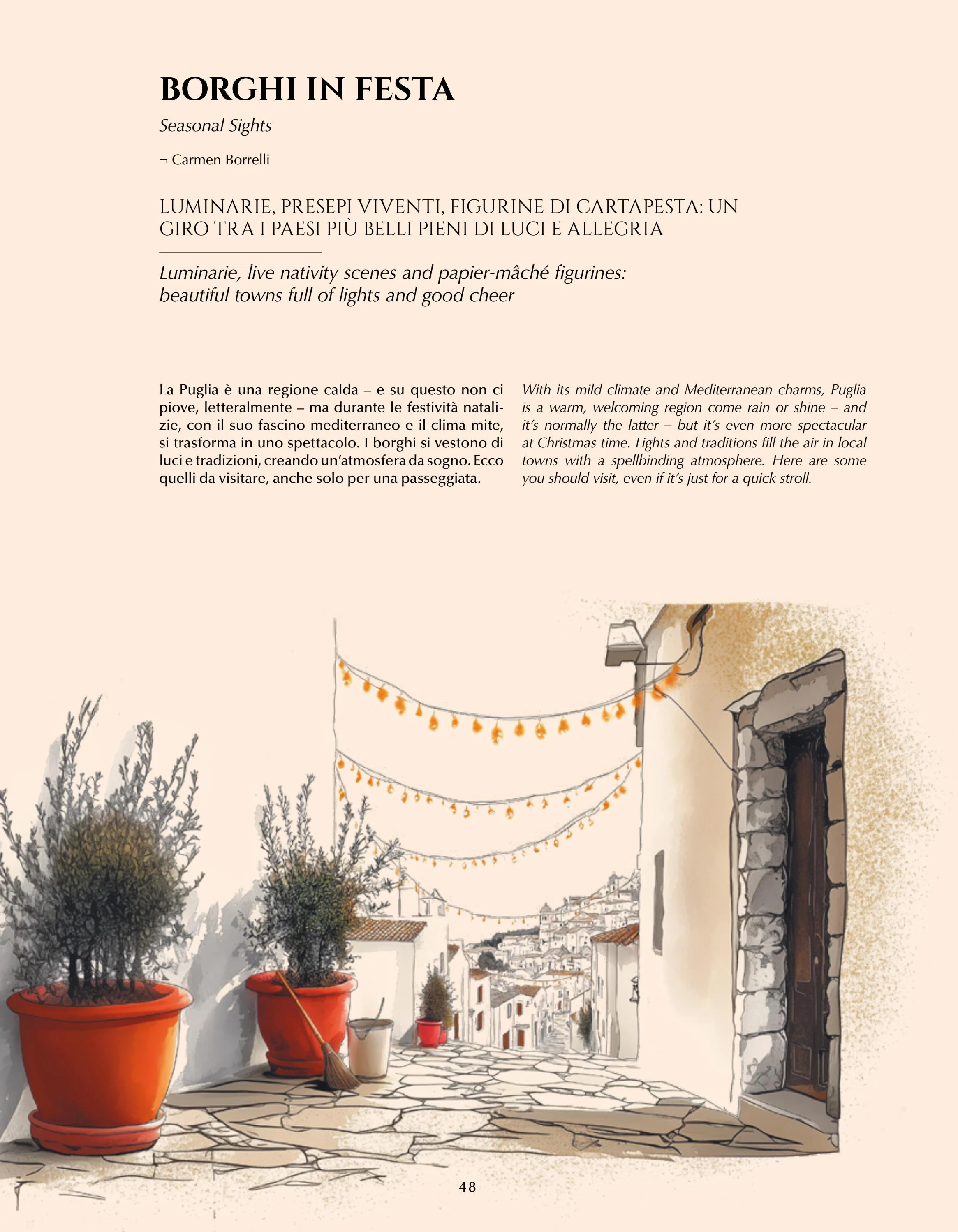
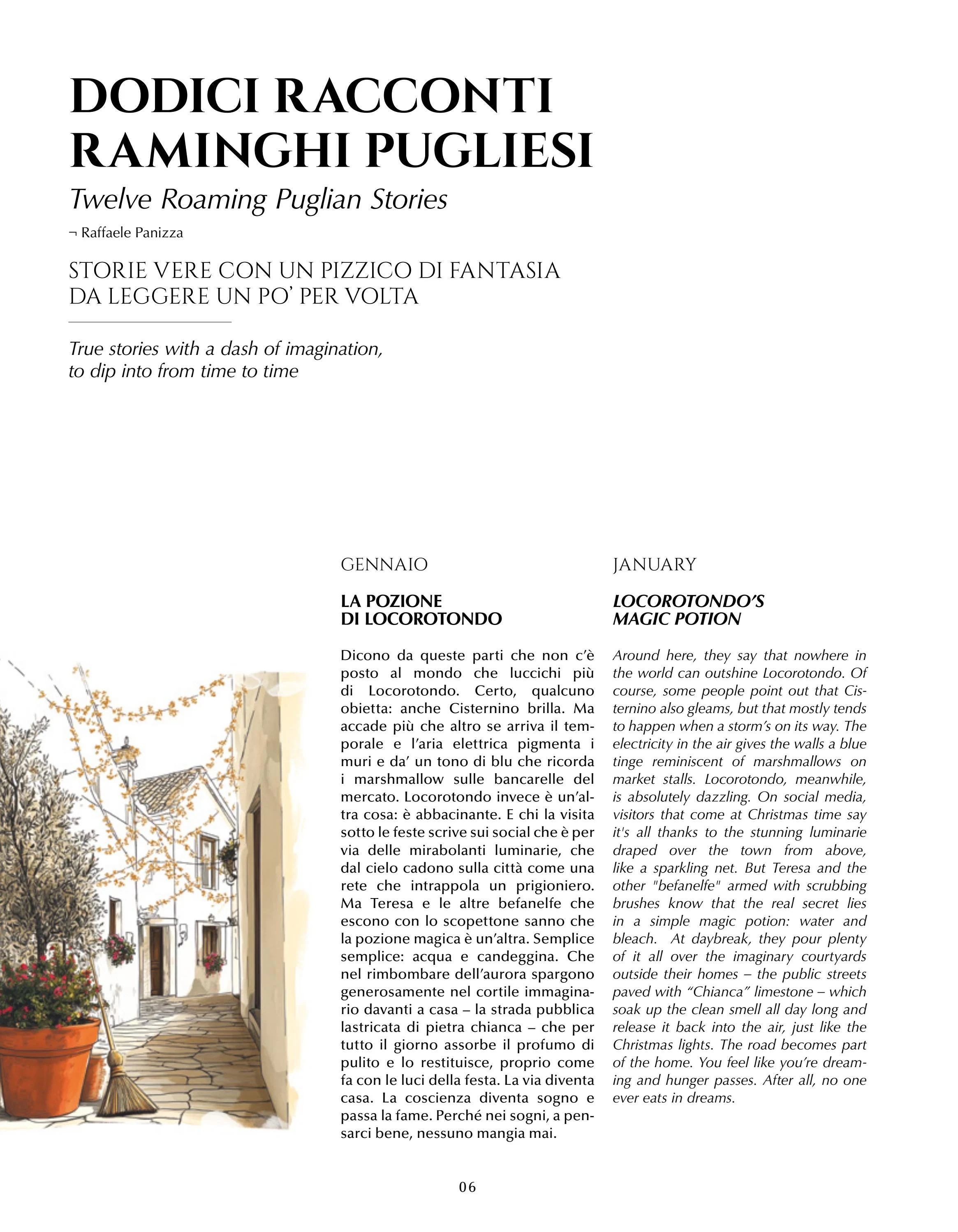
Dicono da queste parti che non c'è posto al mondo che luccichi più di Locorotondo. Certo, qualcuno obietta: anche Cisternino brilla. Ma accade più che altro se arriva il temporale e laria elettrica pigmenta i muri e da’ un tono di blu che ricorda i marshmallow sulle bancarelle del mercato. Locorotondo invece è un‘altra cosa: è abbacinante. E chi la visita sotto le feste scrive sui social che è per via delle mirabolanti luminarie, che dal cielo cadono sulla citta come una rete che intrappola un prigioniero. Ma Teresa e le altre befanelfe che escono con lo scopettone sanno che la pozione magica è un‘altra. Semplice semplice: acqua e candeggina. Che nel rimbombare dell’aurora spargono generosamente nel cortile immaginario davanti a casa — la strada pubblica lastricata di pietra chianca — che per tutto il giorno assorbe il profumo di pulito e lo restituisce, proprio come fa con le luci della festa. La via diventa casa. La coscienza diventa sogno e passa la fame. Perché nei sogni, a pensarci bene, nessuno mangia mai.
## FEBBRAIO — IL GATTO GUERCIO
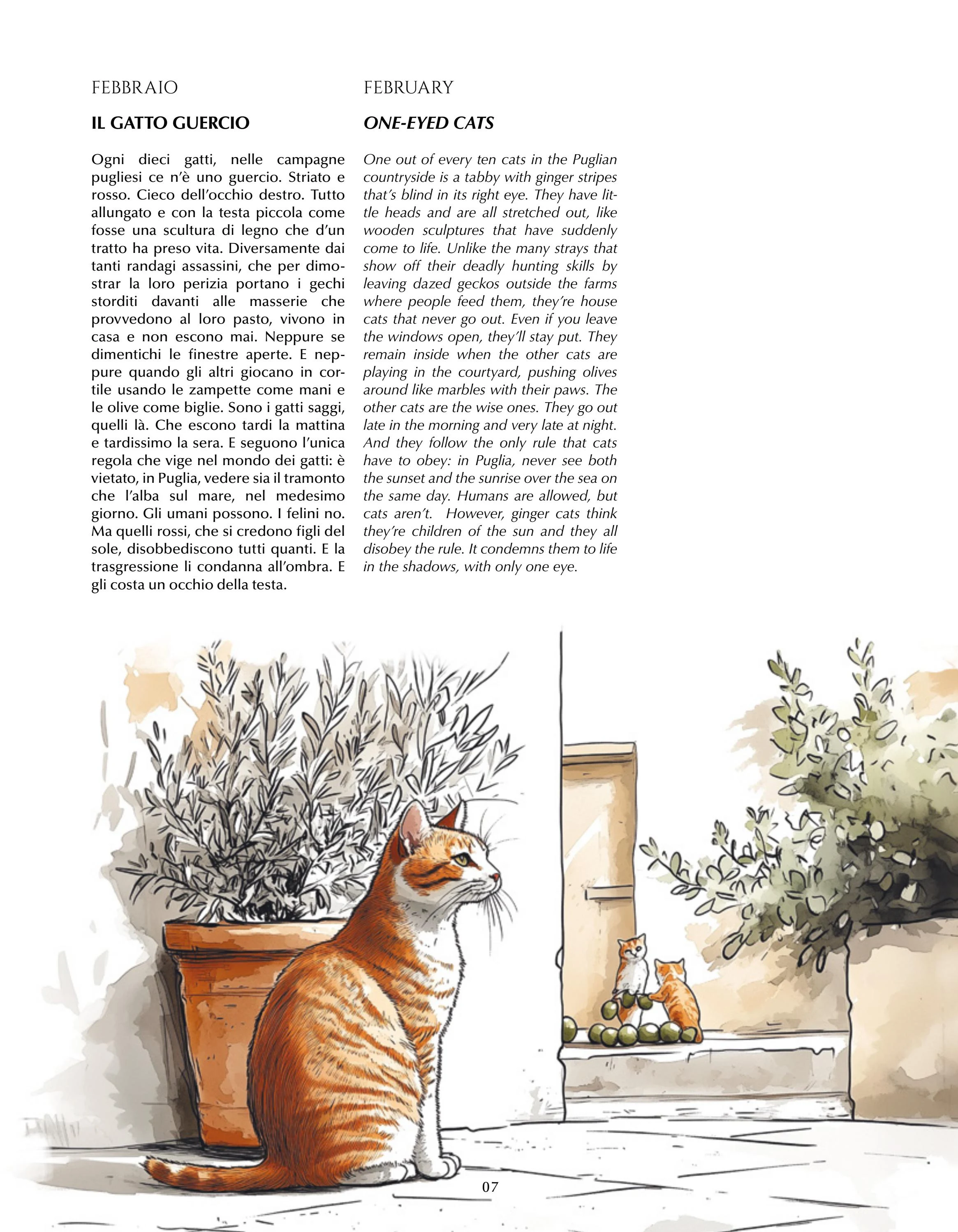
Ogni dieci gatti, nelle campagne pugliesi ce n’è uno guercio. Striato e rosso. Cieco dell’occhio destro. Tutto allungato e con la testa piccola come fosse una scultura di legno che d’un tratto ha preso vita. Diversamente dai tanti randagi assassini, che per dimostrar la loro perizia portano i gechi storditi davanti alle masserie che provvedono al loro pasto, vivono in casa e non escono mai. Neppure se dimentichi le finestre aperte. E neppure quando gli altri giocano in cortile usando le zampette come mani e le olive come biglie. Sono i gatti saggi, quelli là. Che escono tardi la mattina e tardissimo la sera. E seguono l’unica regola che vige nel mondo dei gatti: è vietato, in Puglia, vedere sia il tramonto che l’alba sul mare, nel medesimo giorno. Gli umani possono. I felini no. Ma quelli rossi, che si credono figli del sole, disobbediscono tutti quanti. E la trasgressione li condanna all'ombra. E gli costa un occhio della testa.
## MARZO — GLI INSETTI PITTORI
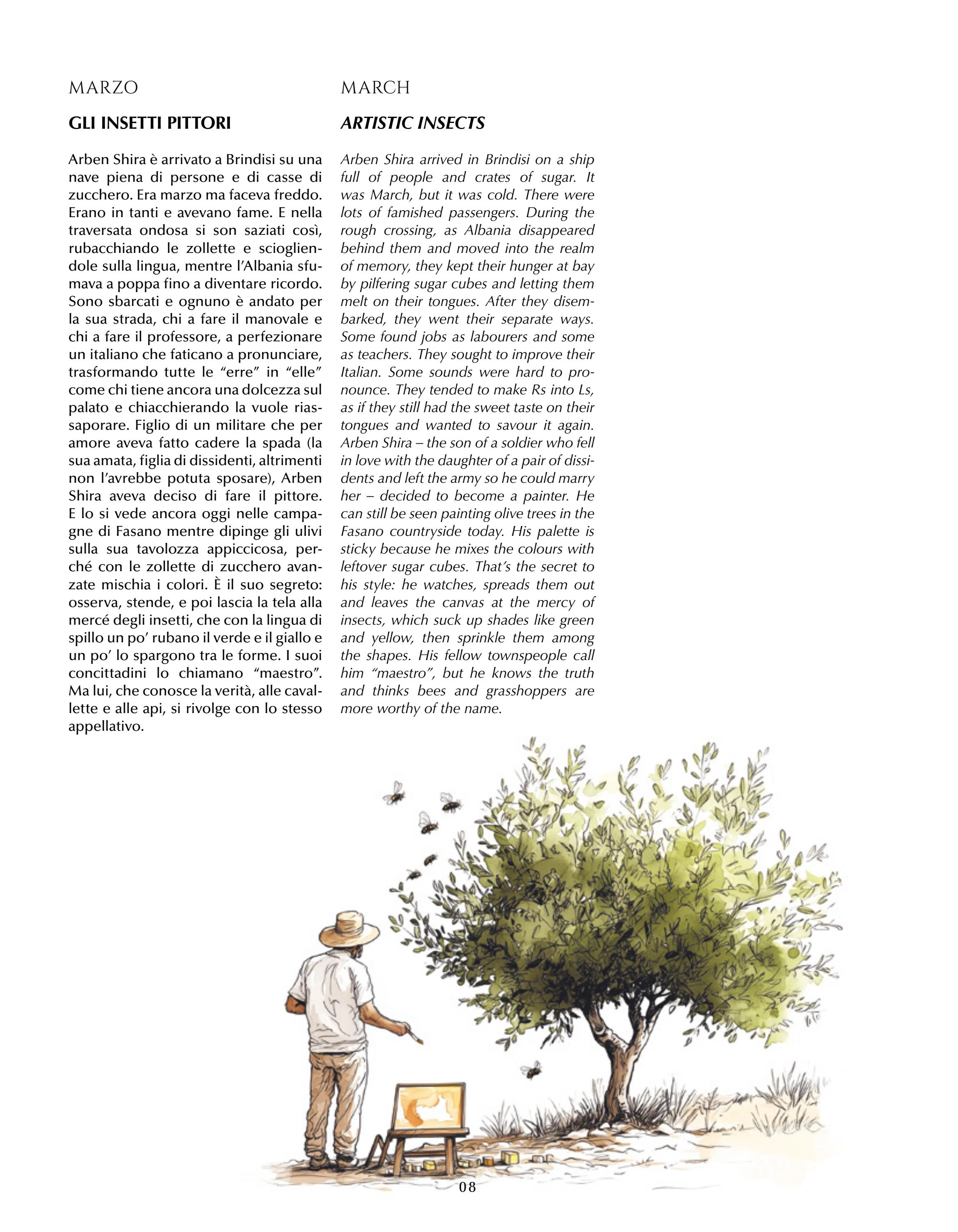
Arben Shira è arrivato a Brindisi su una nave piena di persone e di casse di zucchero. Era marzo ma faceva freddo. Erano in tanti e avevano fame. E nella traversata ondosa si son saziati così, rubacchiando le zollette e sciogliendole sulla lingua, mentre l’Albania sfumava a poppa fino a diventare ricordo. Sono sbarcati e ognuno è andato per la sua strada, chi a fare il manovale e chi a fare il professore, a perfezionare un italiano che faticano a pronunciare, trasformando tutte le “erre” in “elle” come chi tiene ancora una dolcezza sul palato e chiacchierando la vuole riassaporare. Figlio di un militare che per amore aveva fatto cadere la spada (la sua amata, figlia di dissidenti, altrimenti non l'avrebbe potuta sposare), Arben Shira aveva deciso di fare il pittore. E lo si vede ancora oggi nelle campagne di Fasano mentre dipinge gli ulivi sulla sua tavolozza appiccicosa, perché con le zollette di zucchero avanzate mischia i colori. E il suo segreto: osserva, stende, e poi lascia la tela alla mercé degli insetti, che con la lingua di spillo un po’ rubano il verde e il giallo e un po’ lo spargono tra le forme. I suoi concittadini lo chiamano “maestro”. Ma lui, che conosce la verita, alle cavallette e alle api, si rivolge con lo stesso appellativo.
## APRILE — IL FORNO DI BETTYS
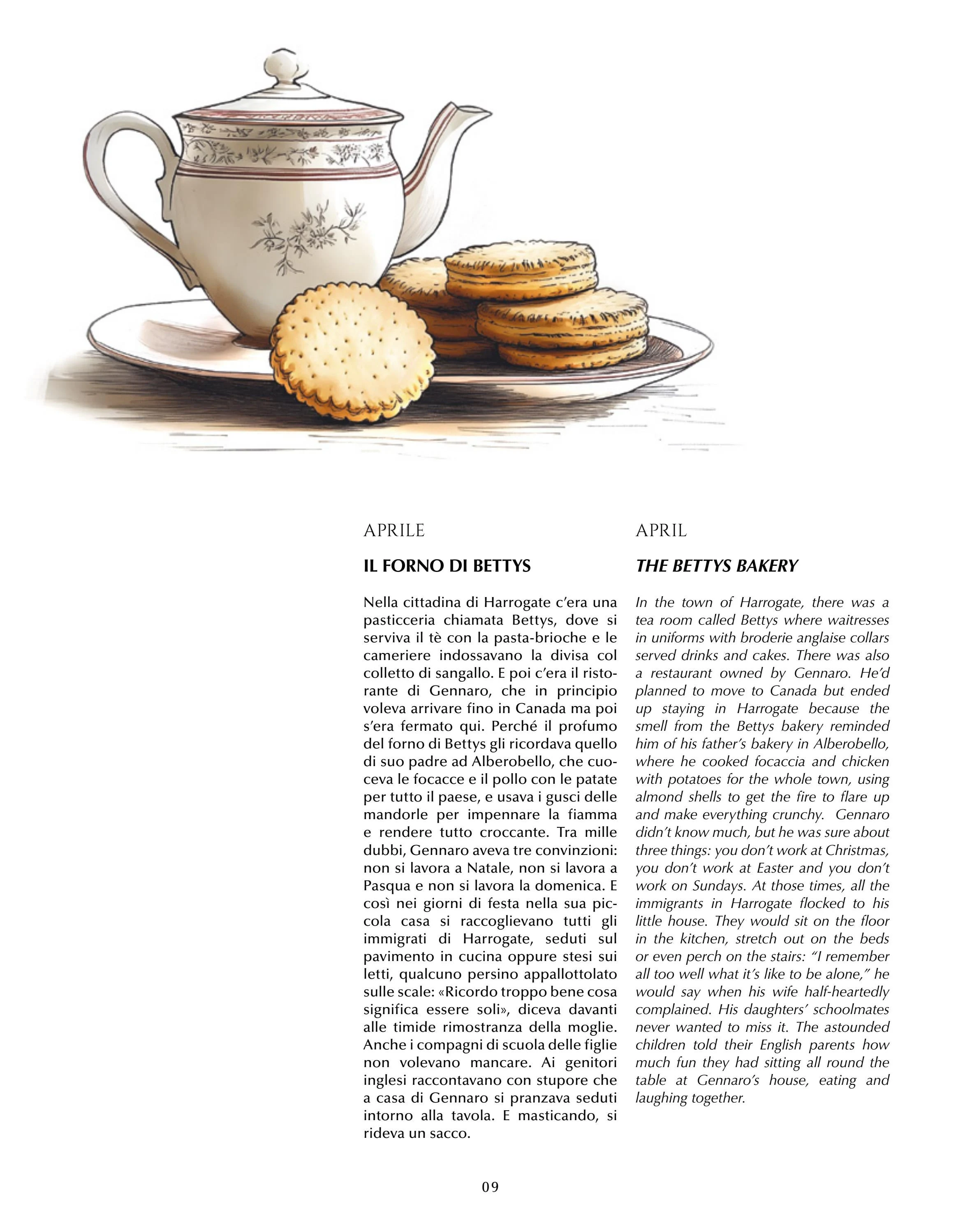
Nella cittadina di Harrogate c’era una pasticceria chiamata Bettys, dove si serviva il tè con la pasta-brioche e le cameriere indossavano la divisa col colletto di sangallo. E poi c’era il ristorante di Gennaro, che in principio voleva arrivare fino in Canada ma poi s’era fermato qui. Perché il profumo del forno di Bettys gli ricordava quello di suo padre ad Alberobello, che cuoceva le focacce e il pollo con le patate per tutto il paese, e usava i gusci delle mandorle per impennare la fiamma e rendere tutto croccante. Tra mille dubbi, Gennaro aveva tre convinzioni: non si lavora a Natale, non si lavora a Pasqua e non si lavora la domenica. E cosi nei giorni di festa nella sua piccola casa si raccoglievano tutti gli immigrati di Harrogate, seduti sul pavimento in cucina oppure stesi sui letti, qualcuno persino appallottolato sulle scale: «Ricordo troppo bene cosa significa essere soli», diceva davanti alle timide rimostranza della moglie. Anche i compagni di scuola delle figlie non volevano mancare. Ai genitori inglesi raccontavano con stupore che a casa di Gennaro si pranzava seduti intorno alla tavola. E masticando, si rideva un sacco.
## MAGGIO — IL CERAMISTA ENTRATO DALLA FINESTRA
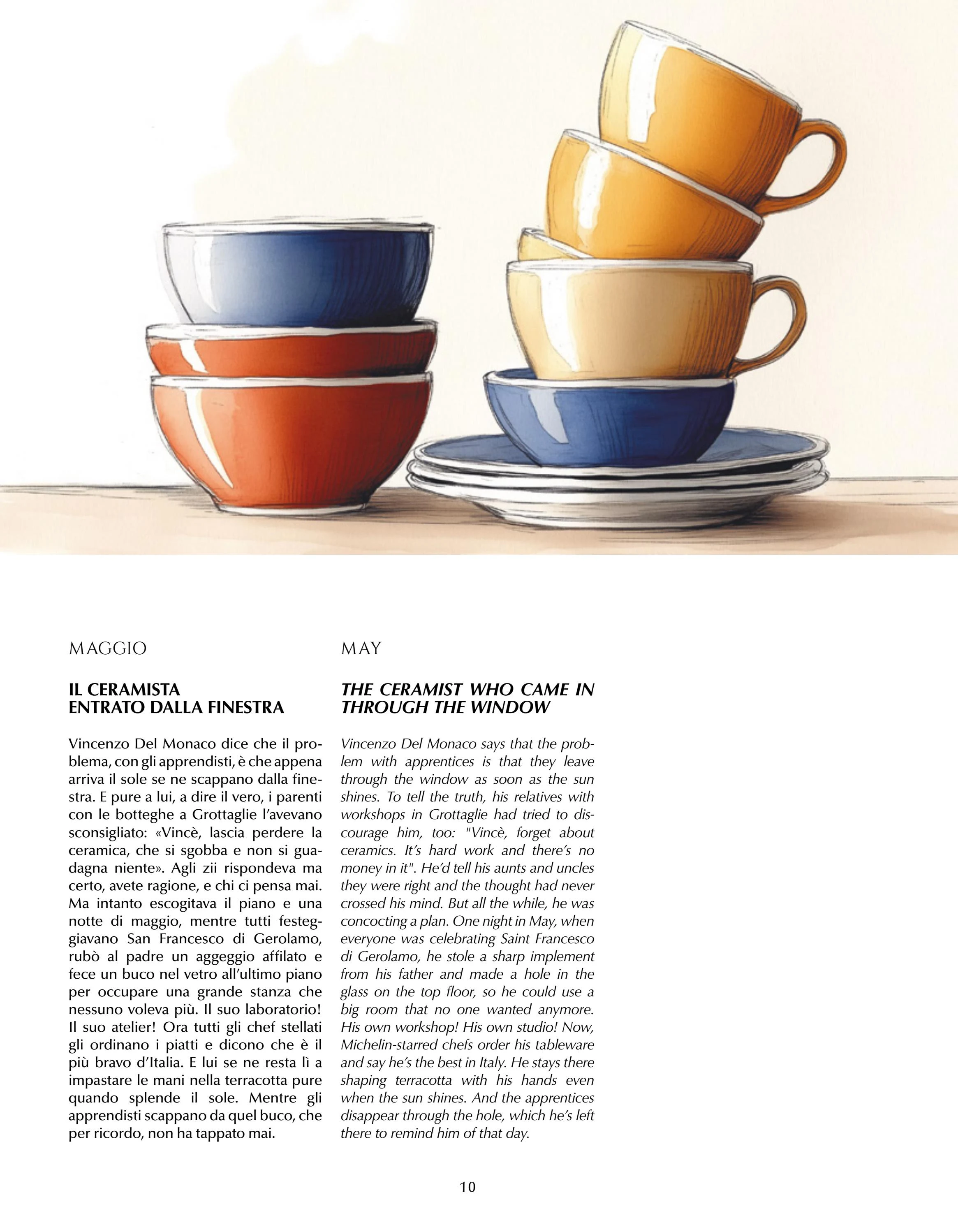
Vincenzo Del Monaco dice che il problema, con gli apprendisti, è che appena arriva il sole se ne scappano dalla finestra. E pure a lui, a dire il vero, i parenti con le botteghe a Grottaglie l’avevano sconsigliato: «Vincè, lascia perdere la ceramica, che si sgobba e non si guadagna niente». Agli zii rispondeva ma certo, avete ragione, e chi ci pensa mai. Ma intanto escogitava il piano e una notte di maggio, mentre tutti festeggiavano San Francesco di Gerolamo, rubò al padre un aggeggio affilato e fece un buco nel vetro all’ultimo piano per occupare una grande stanza che nessuno voleva più. Il suo laboratorio! Il suo atelier! Ora tutti gli chef stellati gli ordinano i piatti e dicono che è il più bravo d’Italia. E lui se ne resta lì a impastare le mani nella terracotta pure quando splende il sole. Mentre gli apprendisti scappano da quel buco, che per ricordo, non ha tappato mai.
## GIUGNO — IL BOSCO TRULLALLERO
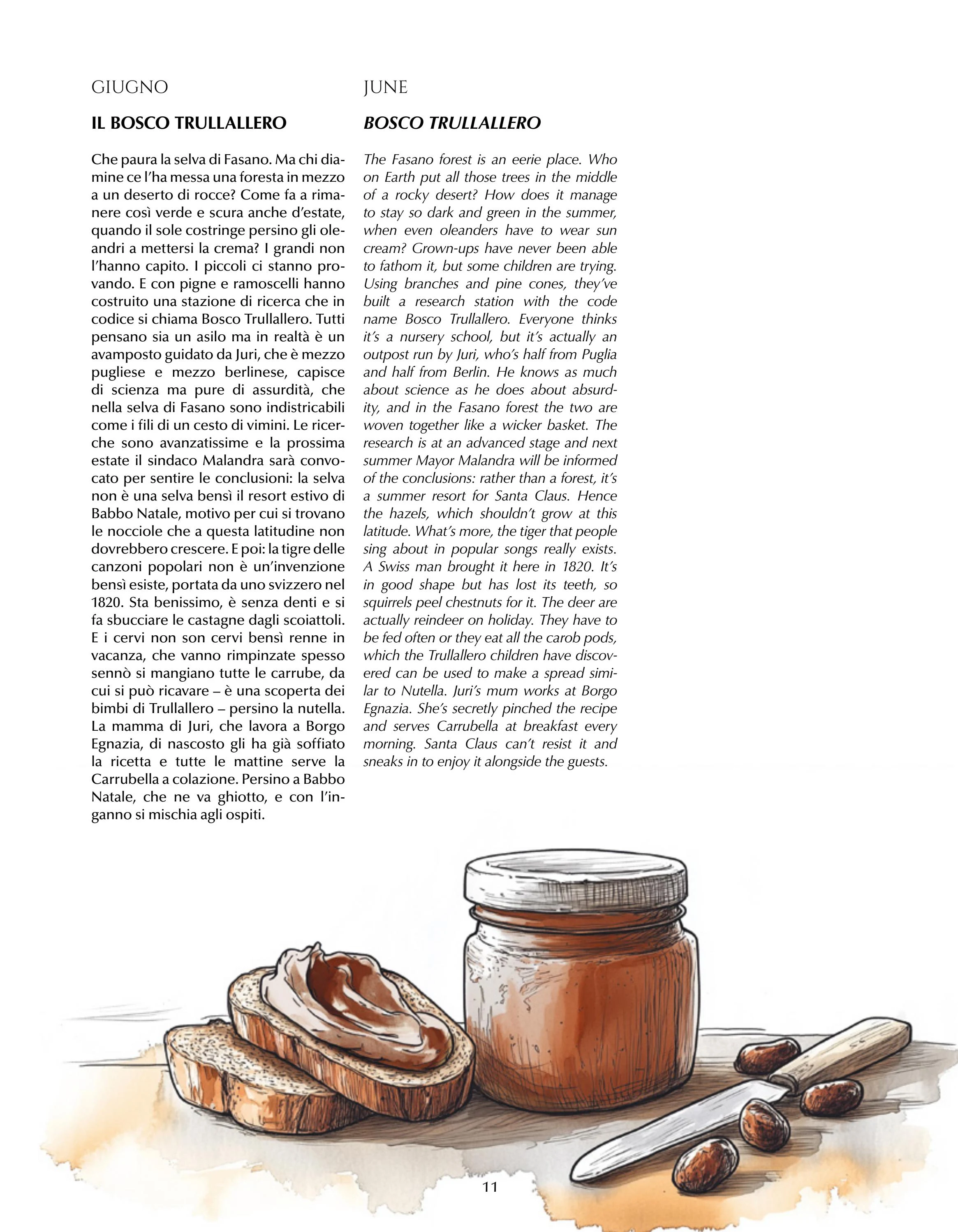
Che paura la selva di Fasano. Ma chi diamine ce l'ha messa una foresta in mezzo a un deserto di rocce? Come fa a rimanere così verde e scura anche d'estate, quando il sole costringe persino gli oleandri a mettersi la crema? I grandi non I’'hanno capito. I piccoli ci stanno provando. E con pigne e ramoscelli hanno costruito una stazione di ricerca che in codice si chiama Bosco Trullallero. Tutti pensano sia un asilo ma in realtà è un avamposto guidato da Juri, che è mezzo pugliese e mezzo berlinese, capisce di scienza ma pure di assurdità, che nella selva di Fasano sono indistricabili come i fili di un cesto di vimini. Le ricerche sono avanzatissime e la prossima estate il sindaco Malandra sarà convocato per sentire le conclusioni: la selva non è una selva bensì il resort estivo di Babbo Natale, motivo per cui si trovano le nocciole che a questa latitudine non dovrebbero crescere. E poi: la tigre delle canzoni popolari non è un’invenzione bensi esiste, portata da uno svizzero nel 1820. Sta benissimo, è senza denti e si fa sbucciare le castagne dagli scoiattoli. E i cervi non son cervi bensi renne in vacanza, che vanno rimpinzate spesso senno si mangiano tutte le carrube, da cui si puo ricavare — è una scoperta dei bimbi di Trullallero — persino la nutella. La mamma di Juri, che lavora a Borgo Egnazia, di nascosto gli ha gia soffiato la ricetta e tutte le mattine serve la Carrubella a colazione. Persino a Babbo Natale, che ne va ghiotto, e con l'inganno si mischia agli ospiti.
## LUGLIO — IL POLPO E LA ZAMPA DI GALLINA
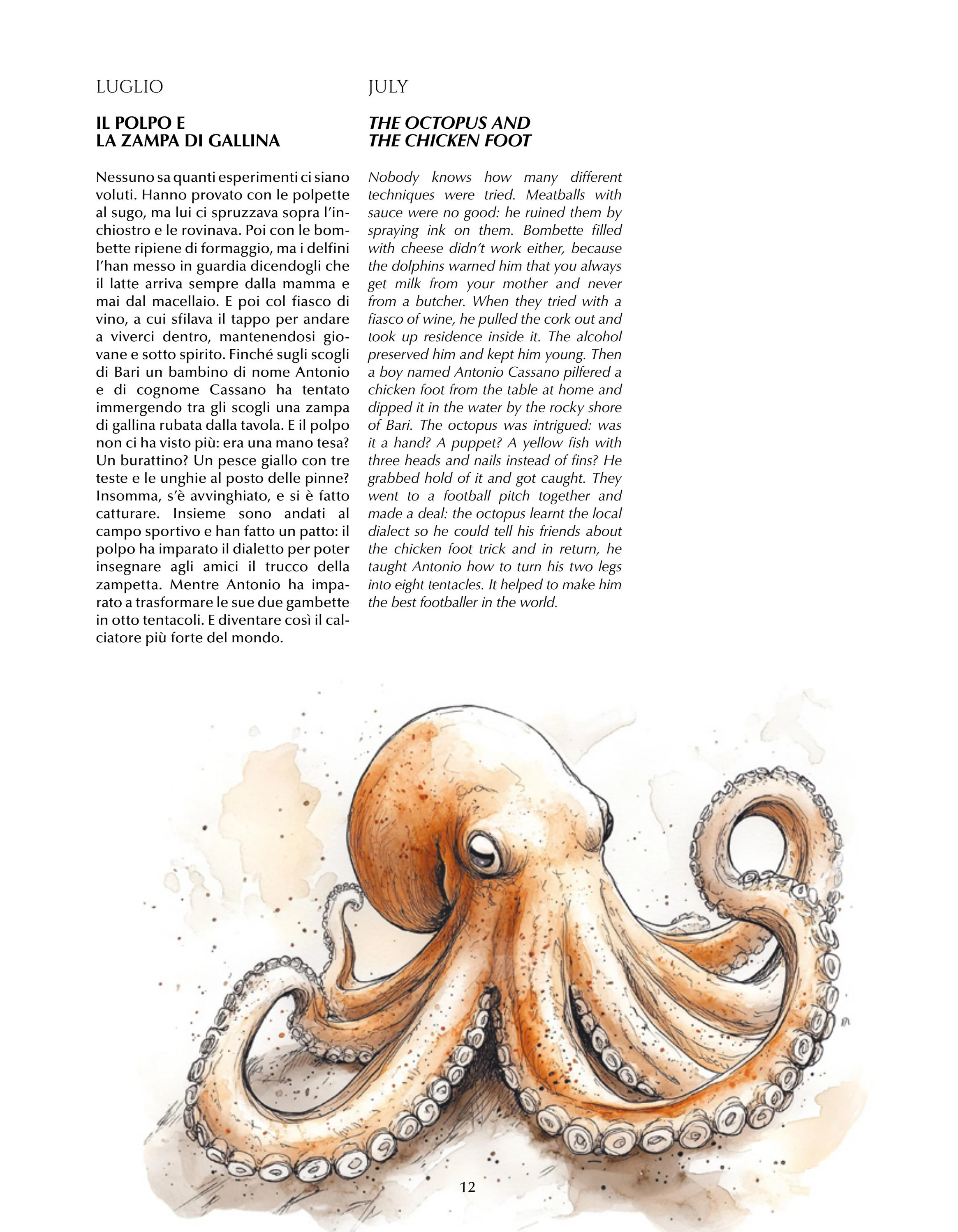
Nessuno sa quanti esperimenti ci siano voluti. Hanno provato con le polpette al sugo, ma lui ci spruzzava sopra l'inchiostro e le rovinava. Poi con le bombette ripiene di formaggio, ma i delfini l'han messo in guardia dicendogli che il latte arriva sempre dalla mamma e mai dal macellaio. E poi col fiasco di vino, a cui sfilava il tappo per andare a viverci dentro, mantenendosi giovane e sotto spirito. Finché sugli scogli di Bari un bambino di nome Antonio e di cognome Cassano ha tentato immergendo tra gli scogli una zampa di gallina rubata dalla tavola. E il polpo non ci ha visto più: era una mano tesa? Un burattino? Un pesce giallo con tre teste e le unghie al posto delle pinne? Insomma, s’è avvinghiato, e si è fatto catturare. Insieme sono andati al campo sportivo e han fatto un patto: il polpo ha imparato il dialetto per poter insegnare agli amici il trucco della zampetta. Mentre Antonio ha imparato a trasformare le sue due gambette in otto tentacoli. E diventare cosi il calciatore piu forte del mondo.
## AGOSTO — TONUCCIO E TONETTA
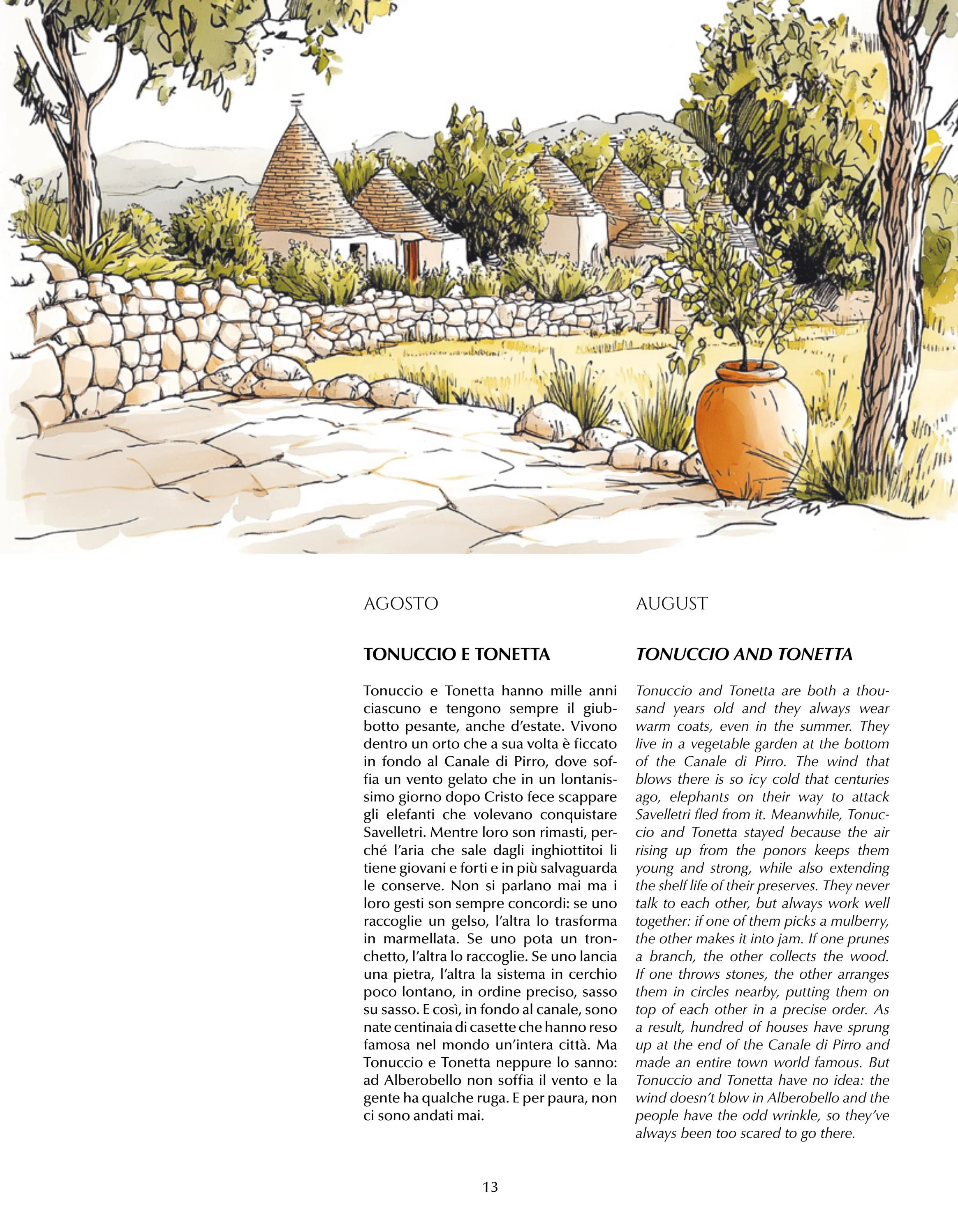
Tonuccio e Tonetta hanno mille anni ciascuno e tengono sempre il giubbotto pesante, anche d’estate. Vivono dentro un orto che a sua volta è ficcato in fondo al Canale di Pirro, dove soffia un vento gelato che in un lontanissimo giorno dopo Cristo fece scappare gli elefanti che volevano conquistare Savelletri. Mentre loro son rimasti, perché l’aria che sale dagli inghiottitoi li tiene giovani e forti e in più salvaguarda le conserve. Non si parlano mai ma i loro gesti son sempre concordi: se uno raccoglie un gelso, l'altra lo trasforma in marmellata. Se uno pota un tronchetto, l’altra lo raccoglie. Se uno lancia una pietra, l'altra la sistema in cerchio poco lontano, in ordine preciso, sasso su sasso. E cosi, in fondo al canale, sono nate centinaia di casette che hanno reso famosa nel mondo un’intera citta. Ma Tonuccio e Tonetta neppure lo sanno: ad Alberobello non soffia il vento e la gente ha qualche ruga. E per paura, non ci sono andati mai.
## SETTEMBRE — LA NEVE E LE RADICI
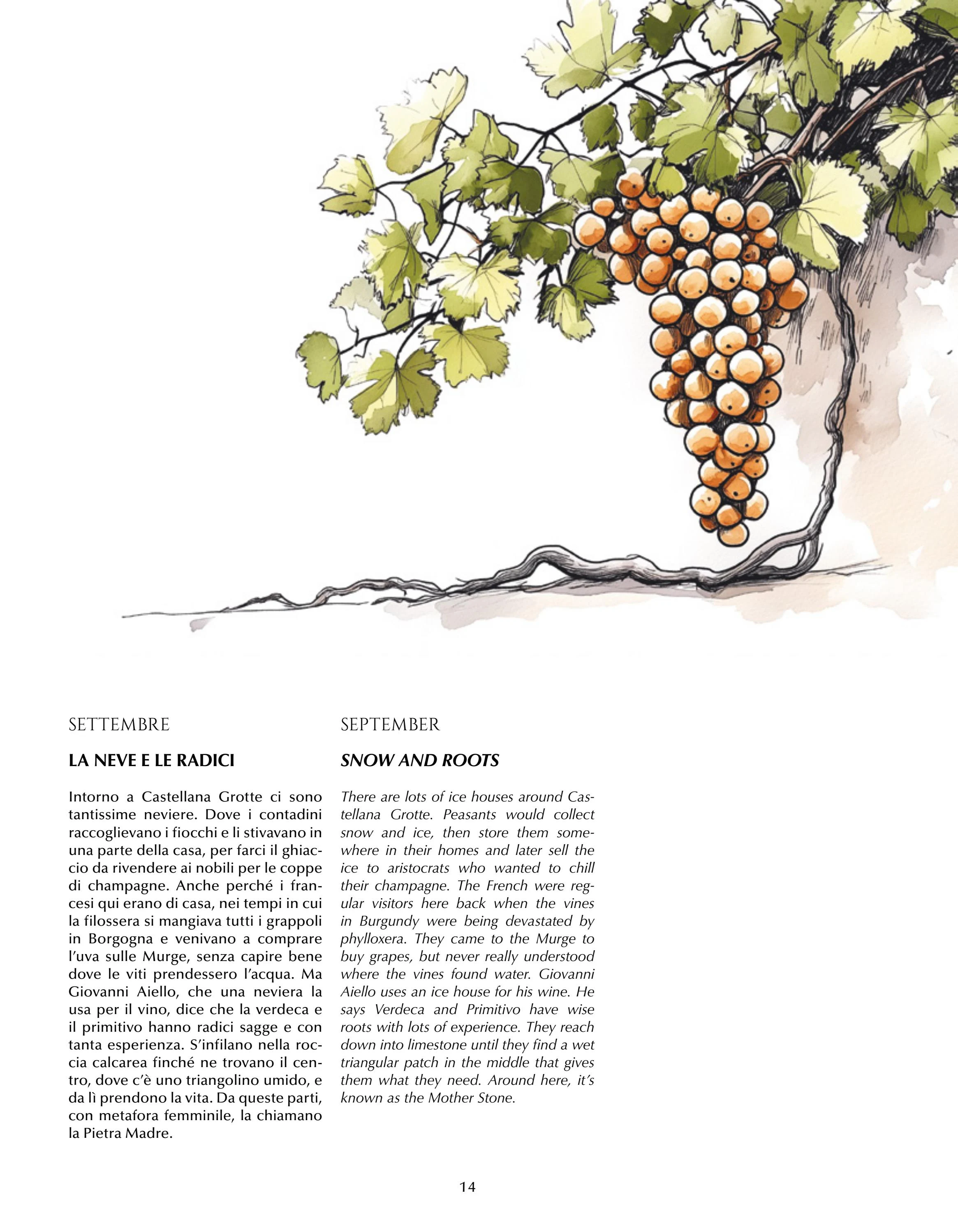
Intorno a Castellana Grotte ci sono tantissime neviere. Dove i contadini raccoglievano i fiocchi e li stivavano in una parte della casa, per farci il ghiaccio da rivendere ai nobili per le coppe di champagne. Anche perché i francesi qui erano di casa, nei tempi in cui la filossera si mangiava tutti i grappoli in Borgogna e venivano a comprare l’uva sulle Murge, senza capire bene dove le viti prendessero l’acqua. Ma Giovanni Aiello, che una neviera la usa per il vino, dice che la verdeca e il primitivo hanno radici sagge e con tanta esperienza. S'infilano nella roccia calcarea finché ne trovano il centro, dove c’e uno triangolino umido, e da lì prendono la vita. Da queste parti, con metafora femminile, la chiamano la Pietra Madre.
## OTTOBRE — LA CONFUSIONE DEL GRECALE
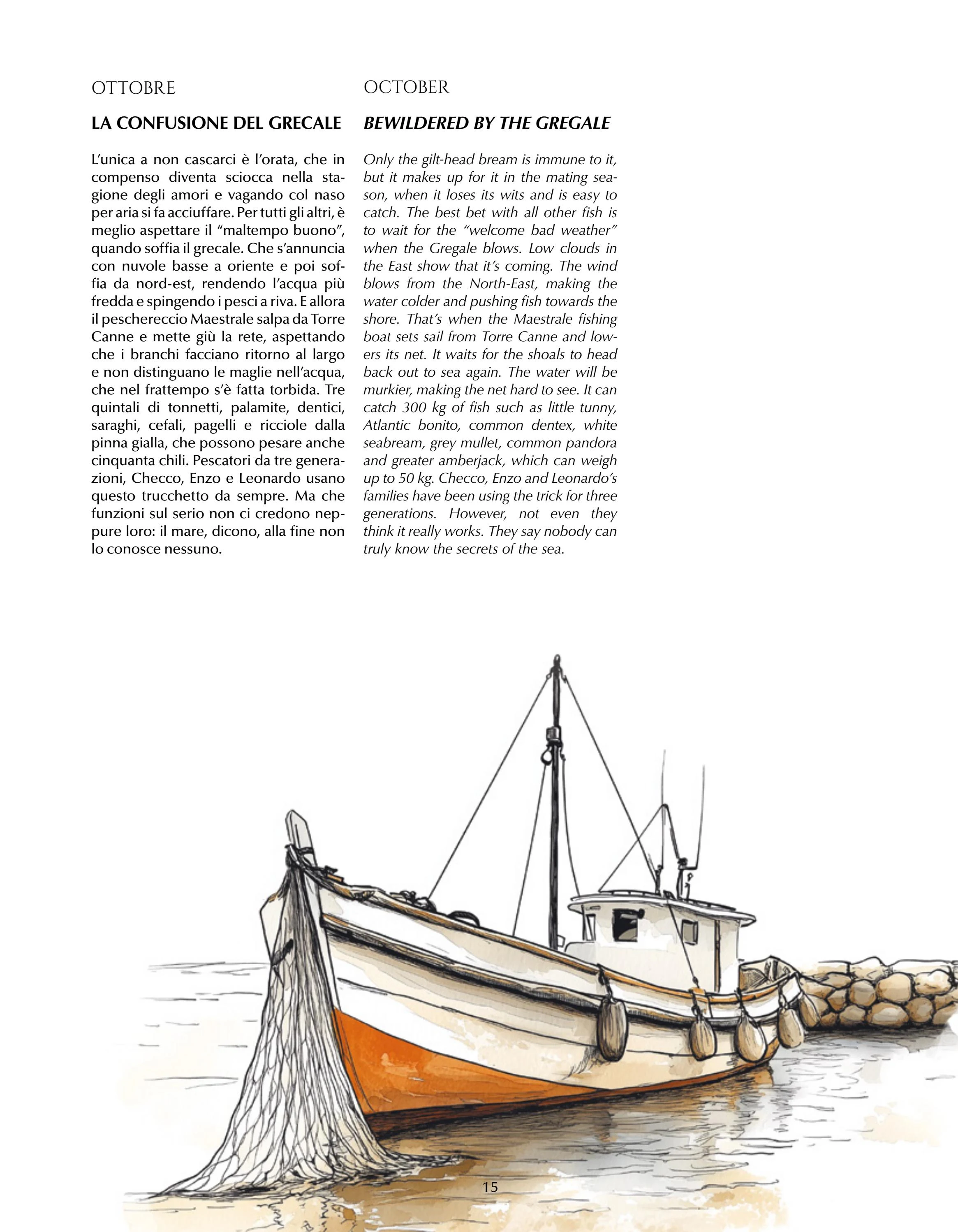
L'unica a non cascarci è l’orata, che in compenso diventa sciocca nella stagione degli amori e vagando col naso per aria si fa acciuffare. Per tutti gli altri, è meglio aspettare il “maltempo buono”, quando soffia il grecale. Che s'annuncia con nuvole basse a oriente e poi soffia da nord-est, rendendo l'acqua più fredda e spingendo i pesciariva. Eallora il peschereccio Maestrale salpa da Torre Canne e mette giu la rete, aspettando che i branchi facciano ritorno al largo e non distinguano le maglie nell'acqua, che nel frattempo s’e fatta torbida. Tre quintali di tonnetti, palamite, dentici, saraghi, cefali, pagelli e ricciole dalla pinna gialla, che possono pesare anche cinquanta chili. Pescatori da tre generazioni, Checco, Enzo e Leonardo usano questo trucchetto da sempre. Ma che funzioni sul serio non ci credono neppure loro: il mare, dicono, alla fine non lo conosce nessuno.
## NOVEMBRE — PAPPAGALLI E MELAGRANE
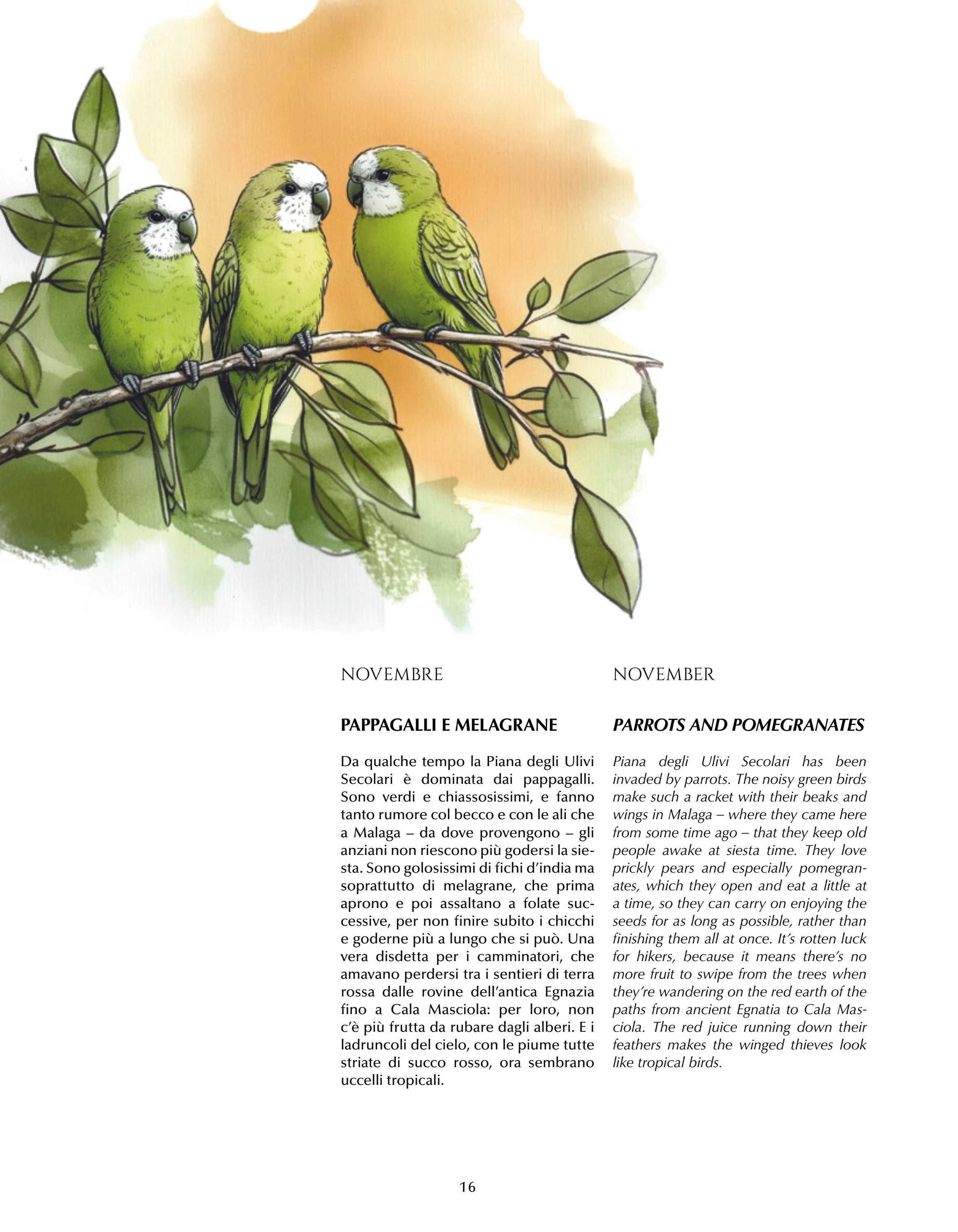
Da qualche tempo la Piana degli Ulivi Secolari è dominata dai pappagalli. Sono verdi e chiassosissimi, e fanno tanto rumore col becco e con le ali che a Malaga — da dove provengono - gli anziani non riescono più godersi la siesta. Sono golosissimi di fichi d’india ma soprattutto di melagrane, che prima aprono e poi assaltano a folate successive, per non finire subito i chicchi e goderne più a lungo che si può. Una vera disdetta per i camminatori, che amavano perdersi tra i sentieri di terra rossa dalle rovine dell’antica Egnazia fino a Cala Masciola: per loro, non c'è più frutta da rubare dagli alberi. E i ladruncoli del cielo, con le piume tutte striate di succo rosso, ora sembrano uccelli tropicali.
## DICEMBRE — LA PROCESSIONE SULLE SCALE
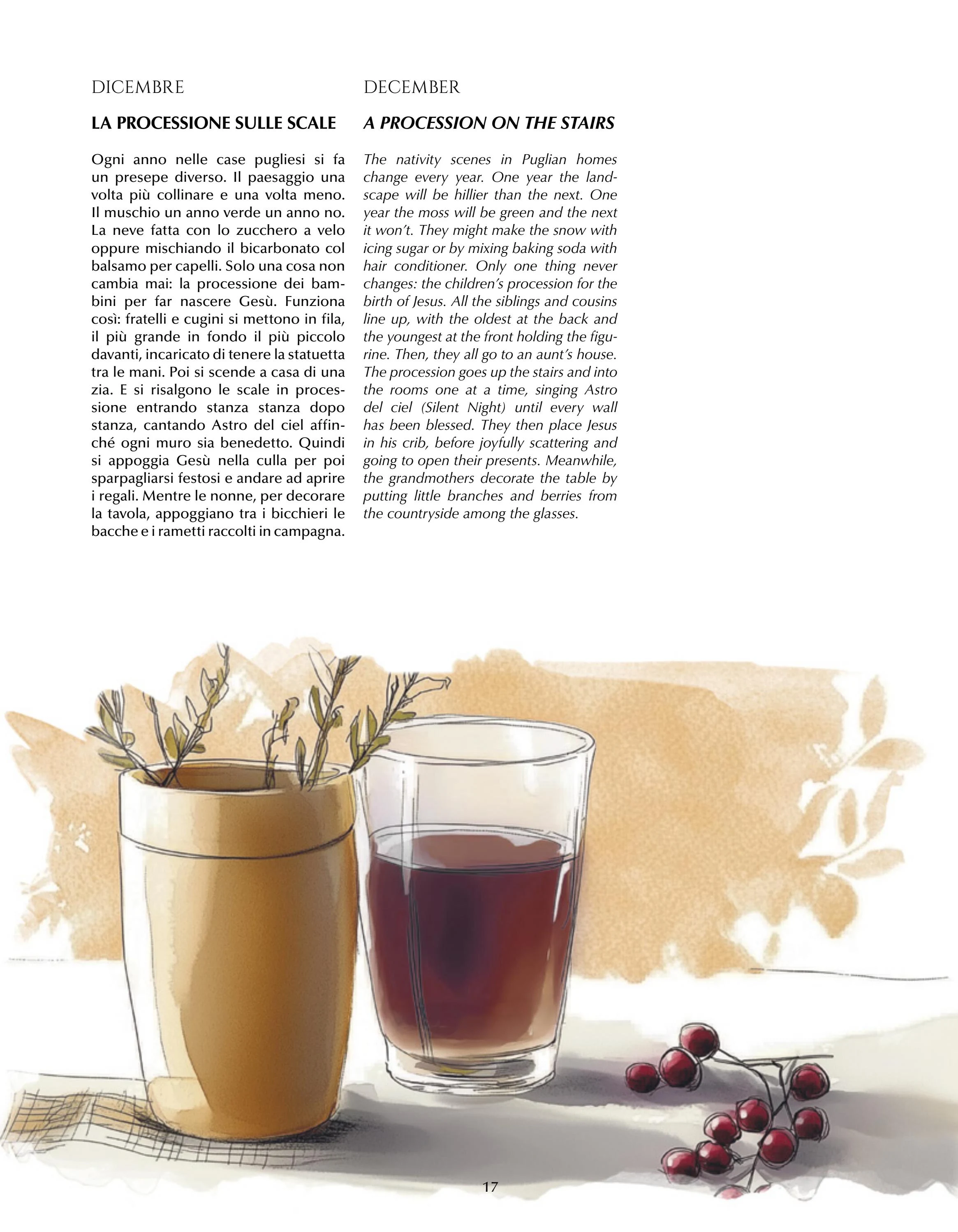
Ogni anno nelle case pugliesi si fa un presepe diverso. Il paesaggio una volta più collinare e una volta meno. Il muschio un anno verde un anno no. La neve fatta con lo zucchero a velo oppure mischiando il bicarbonato col balsamo per capelli. Solo una cosa non cambia mai: la processione dei bambini per far nascere Gesù. Funziona così: fratelli e cugini si mettono in fila, il più grande in fondo il più piccolo davanti, incaricato di tenere la statuetta tra le mani. Poi si scende a casa di una zia. E si risalgono le scale in processione entrando stanza stanza dopo stanza, cantando Astro del ciel affinché ogni muro sia benedetto. Quindi si appoggia Gesù nella culla per poi sparpagliarsi festosi e andare ad aprire i regali. Mentre le nonne, per decorare la tavola, appoggiano tra i bicchieri le bacche e i rametti raccolti in campagna.
## JANUARY — LOCOROTONDO’S MAGIC POTION
Around here, they say that nowhere in the world can outshine Locorotondo. Of course, some people point out that Cisternino also gleams, but that mostly tends to happen when a storm’s on its way. The electricity in the air gives the walls a blue tinge reminiscent of marshmallows on market stalls. Locorotondo, meanwhile, is absolutely dazzling. On social media, visitors that come at Christmas time say it's all thanks to the stunning luminarie draped over the town from above, like a sparkling net. But Teresa and the other "befanelfe" armed with scrubbing brushes know that the real secret lies in a simple magic potion: water and bleach. At daybreak, they pour plenty of it all over the imaginary courtyards outside their homes — the public streets paved with “Chianca” limestone — which soak up the clean smell all day long and release it back into the air, just like the Christmas lights. The road becomes part of the home. You feel like you're dreaming and hunger passes. After all, no one ever eats in dreams.
## FEBRUARY — ONE-EYED CATS
One out of every ten cats in the Puglian countryside is a tabby with ginger stripes that’s blind in its right eye. They have little heads and are all stretched out, like wooden sculptures that have suddenly come to life. Unlike the many strays that show off their deadly hunting skills by leaving dazed geckos outside the farms where people feed them, they’re house cats that never go out. Even if you leave the windows open, they’ll stay put. They remain inside when the other cats are playing in the courtyard, pushing olives around like marbles with their paws. The other cats are the wise ones. They go out late in the morning and very late at night. And they follow the only rule that cats have to obey: in Puglia, never see both the sunset and the sunrise over the sea on the same day. Humans are allowed, but cats aren’t. However, ginger cats think they're children of the sun and they all disobey the rule. It condemns them to life in the shadows, with only one eye.
## MARCH — ARTISTIC INSECTS
Arben Shira arrived in Brindisi on a ship full of people and crates of sugar. It was March, but it was cold. There were lots of famished passengers. During the rough crossing, as Albania disappeared behind them and moved into the realm of memory, they kept their hunger at bay by pilfering sugar cubes and letting them melt on their tongues. After they disembarked, they went their separate ways. Some found jobs as labourers and some as teachers. They sought to improve their Italian. Some sounds were hard to pronounce. They tended to make Rs into Ls, as if they still had the sweet taste on their tongues and wanted to savour it again. Arben Shira — the son of a soldier who fell in love with the daughter of a pair of dissidents and left the army so he could marry her — decided to become a painter. He can still be seen painting olive trees in the Fasano countryside today. His palette is sticky because he mixes the colours with leftover sugar cubes. That’s the secret to his style: he watches, spreads them out and leaves the canvas at the mercy of insects, which suck up shades like green and yellow, then sprinkle them among the shapes. His fellow townspeople call him “maestro”, but he knows the truth and thinks bees and grasshoppers are more worthy of the name.
## APRIL — THE BETTYS BAKERY
In the town of Harrogate, there was a tea room called Bettys where waitresses in uniforms with broderie anglaise collars served drinks and cakes. There was also a restaurant owned by Gennaro. He'd planned to move to Canada but ended up staying in Harrogate because the smell from the Bettys bakery reminded him of his father’s bakery in Alberobello, where he cooked focaccia and chicken with potatoes for the whole town, using almond shells to get the fire to flare up and make everything crunchy. Gennaro didn’t know much, but he was sure about three things: you don’t work at Christmas, you don’t work at Easter and you don’t work on Sundays. At those times, all the immigrants in Harrogate flocked to his little house. They would sit on the floor in the kitchen, stretch out on the beds or even perch on the stairs: “I remember all too well what it’s like to be alone,” he would say when his wife half-heartedly complained. His daughters’ schoolmates never wanted to miss it. The astounded children told their English parents how much fun they had sitting all round the table at Gennaro’s house, eating and laughing together.
## MAY — THE CERAMIST WHO CAME IN THROUGH THE WINDOW
Vincenzo Del Monaco says that the problem with apprentices is that they leave through the window as soon as the sun shines. To tell the truth, his relatives with workshops in Grottaglie had tried to discourage him, too: "Vincè, forget about ceramics. It’s hard work and there’s no money in it". He'd tell his aunts and uncles they were right and the thought had never crossed his mind. But all the while, he was concocting a plan. One night in May, when everyone was celebrating Saint Francesco di Gerolamo, he stole a sharp implement from his father and made a hole in the glass on the top floor, so he could use a big room that no one wanted anymore. His own workshop! His own studio! Now, Michelin-starred chefs order his tableware and say he’s the best in Italy. He stays there shaping terracotta with his hands even when the sun shines. And the apprentices disappear through the hole, which he’s left there to remind him of that day.
## JUNE — BOSCO TRULLALLERO
The Fasano forest is an eerie place. Who on Earth put all those trees in the middle of a rocky desert? How does it manage to stay so dark and green in the summer, when even oleanders have to wear sun cream? Grown-ups have never been able to fathom it, but some children are trying. Using branches and pine cones, they've built a research station with the code name Bosco Trullallero. Everyone thinks it's a nursery school, but it's actually an outpost run by Juri, who’s half from Puglia and half from Berlin. He knows as much about science as he does about absurdity, and in the Fasano forest the two are woven together like a wicker basket. The research is at an advanced stage and next summer Mayor Malandra will be informed of the conclusions: rather than a forest, it’s a summer resort for Santa Claus. Hence the hazels, which shouldn’t grow at this latitude. What’s more, the tiger that people sing about in popular songs really exists. A Swiss man brought it here in 1820. It’s in good shape but has lost its teeth, so squirrels peel chestnuts for it. The deer are actually reindeer on holiday. They have to be fed often or they eat all the carob pods, which the Trullallero children have discovered can be used to make a spread similar to Nutella. Juri’s mum works at Borgo Egnazia. She’s secretly pinched the recipe and serves Carrubella at breakfast every morning. Santa Claus can't resist it and sneaks in to enjoy it alongside the guests.
## JULY — THE OCTOPUS AND THE CHICKEN FOOT
Nobody knows how many different techniques were tried. Meatballs with sauce were no good: he ruined them by spraying ink on them. Bombette filled with cheese didn’t work either, because the dolphins warned him that you always get milk from your mother and never from a butcher. When they tried with a fiasco of wine, he pulled the cork out and took up residence inside it. The alcohol preserved him and kept him young. Then a boy named Antonio Cassano pilfered a chicken foot from the table at home and dipped it in the water by the rocky shore of Bari. The octopus was intrigued: was it a hand? A puppet? A yellow fish with three heads and nails instead of fins? He grabbed hold of it and got caught. They went to a football pitch together and made a deal: the octopus learnt the local dialect so he could tell his friends about the chicken foot trick and in return, he taught Antonio how to turn his two legs into eight tentacles. It helped to make him the best footballer in the world.
## AUGUST — TONUCCIO AND TONETTA
Tonuccio and Tonetta are both a thousand years old and they always wear warm coats, even in the summer. They live in a vegetable garden at the bottom of the Canale di Pirro. The wind that blows there is so icy cold that centuries ago, elephants on their way to attack Savelletri fled from it. Meanwhile, Tonuccio and Tonetta stayed because the air rising up from the ponors keeps them young and strong, while also extending the shelf life of their preserves. They never talk to each other, but always work well together: if one of them picks a mulberry, the other makes it into jam. If one prunes a branch, the other collects the wood. If one throws stones, the other arranges them in circles nearby, putting them on top of each other in a precise order. As a result, hundred of houses have sprung up at the end of the Canale di Pirro and made an entire town world famous. But Tonuccio and Tonetta have no idea: the wind doesn’t blow in Alberobello and the people have the odd wrinkle, so they've always been too scared to go there.
## SEPTEMBER — SNOW AND ROOTS
There are lots of ice houses around Castellana Grotte. Peasants would collect snow and ice, then store them somewhere in their homes and later sell the ice to aristocrats who wanted to chill their champagne. The French were regular visitors here back when the vines in Burgundy were being devastated by phylloxera. They came to the Murge to buy grapes, but never really understood where the vines found water. Giovanni Aiello uses an ice house for his wine. He says Verdeca and Primitivo have wise roots with lots of experience. They reach down into limestone until they find a wet triangular patch in the middle that gives them what they need. Around here, it’s known as the Mother Stone.
## OCTOBER — BEWILDERED BY THE GREGALE
Only the gilt-head bream is immune to it, but it makes up for it in the mating season, when it loses its wits and is easy to catch. The best bet with all other fish is to wait for the “welcome bad weather” when the Gregale blows. Low clouds in the East show that it’s coming. The wind blows from the North-East, making the water colder and pushing fish towards the shore. That’s when the Maestrale fishing boat sets sail from Torre Canne and lowers its net. It waits for the shoals to head back out to sea again. The water will be murkier, making the net hard to see. It can catch 300 kg of fish such as little tunny, Atlantic bonito, common dentex, white seabream, grey mullet, common pandora and greater amberjack, which can weigh up to 50 kg. Checco, Enzo and Leonardo’s families have been using the trick for three generations. However, not even they think it really works. They say nobody can truly know the secrets of the sea.
## NOVEMBER — PARROTS AND POMEGRANATES
Piana degli Ulivi Secolari has been invaded by parrots. The noisy green birds make such a racket with their beaks and wings in Malaga — where they came here from some time ago — that they keep old people awake at siesta time. They love prickly pears and especially pomegranates, which they open and eat a little at a time, so they can carry on enjoying the seeds for as long as possible, rather than finishing them all at once. It’s rotten luck for hikers, because it means there’s no more fruit to swipe from the trees when theyre wandering on the red earth of the paths from ancient Egnatia to Cala Masciola. The red juice running down their feathers makes the winged thieves look like tropical birds.
## DECEMBER — A PROCESSION ON THE STAIRS
The nativity scenes in Puglian homes change every year. One year the landscape will be hillier than the next. One year the moss will be green and the next it won’t. They might make the snow with icing sugar or by mixing baking soda with hair conditioner. Only one thing never changes: the children’s procession for the birth of Jesus. All the siblings and cousins line up, with the oldest at the back and the youngest at the front holding the figurine. Then, they all go to an aunt’s house. The procession goes up the stairs and into the rooms one at a time, singing Astro del ciel (Silent Night) until every wall has been blessed. They then place Jesus in his crib, before joyfully scattering and going to open their presents. Meanwhile, the grandmothers decorate the table by putting little branches and berries from the countryside among the glasses.